The starting point: what JazzMesh actually counts
- 1,328
- discographic objectsAlbums, compilations and releases grouped after editions are deduplicated.
- 1,017
- individual collaboratorsPeople co-credited with Miles Davis in his complete neighbourhood.
- 756
- records as main artistDated objects retained by the Line-ups view.
- 1945–2026
- observed release yearsThe period after 1991 reflects the editorial life of the catalogue.
In the JazzMesh snapshot of 31 August 2026, Discogs identity 23755 — Miles Davis — is connected to 1,328 distinct discographic objects and 1,017 individual collaborators. Of these objects, 756 credit him as the main artist under the reconstruction rules. The earliest observed release year is 1945; the latest is 2026.
These figures describe neither 1,328 original sessions nor a career extending to 2026. JazzMesh groups editions when they refer to the same discographic object, but it also retains compilations, archival releases and posthumous publications. As Miles Davis died in 1991, the long tail after that date primarily measures the editorial circulation of his work. That is information in its own right: the catalogue continues to create encounters between periods, labels and generations of reissues.
A central node, but not a ranking of genius
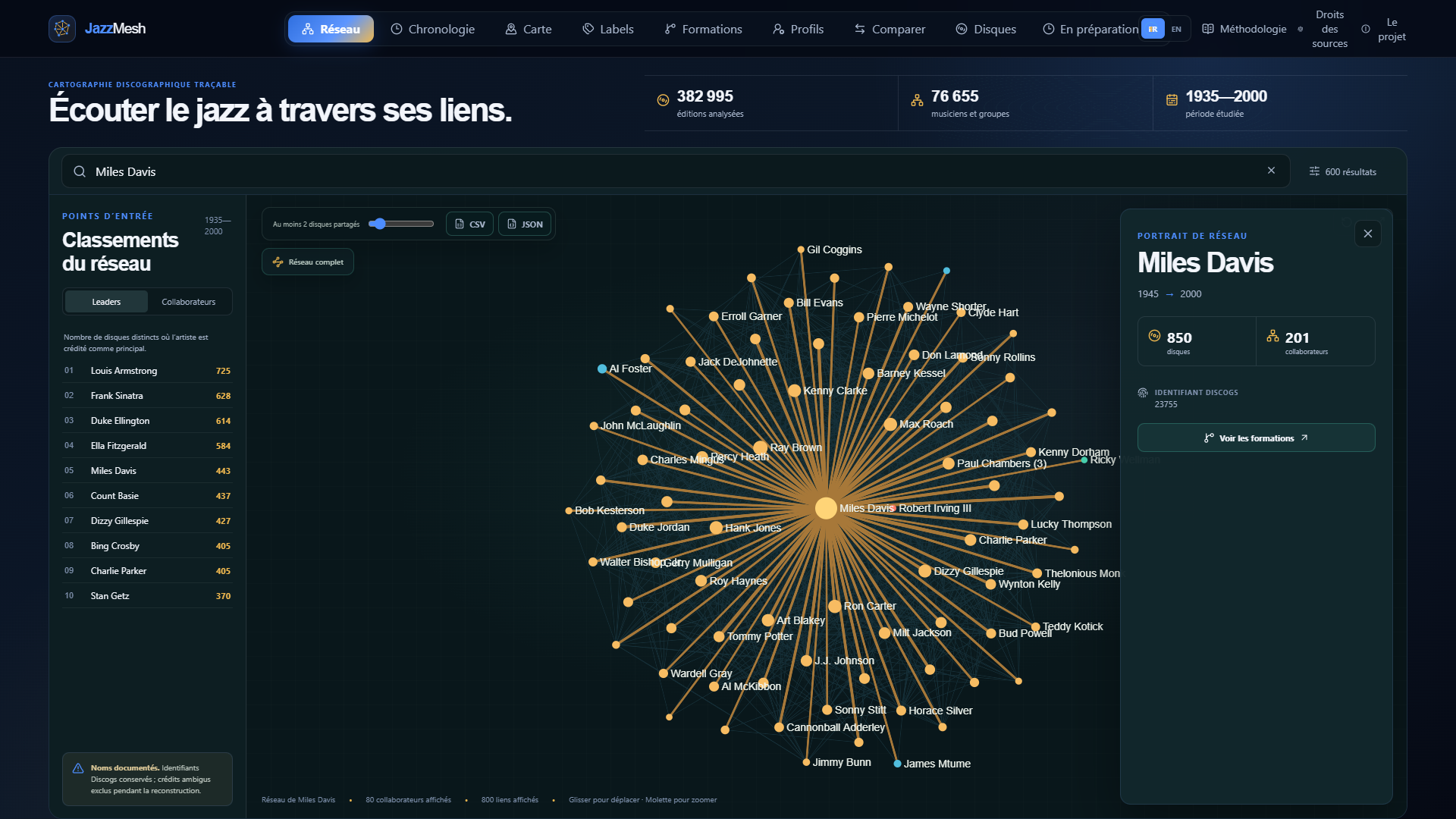
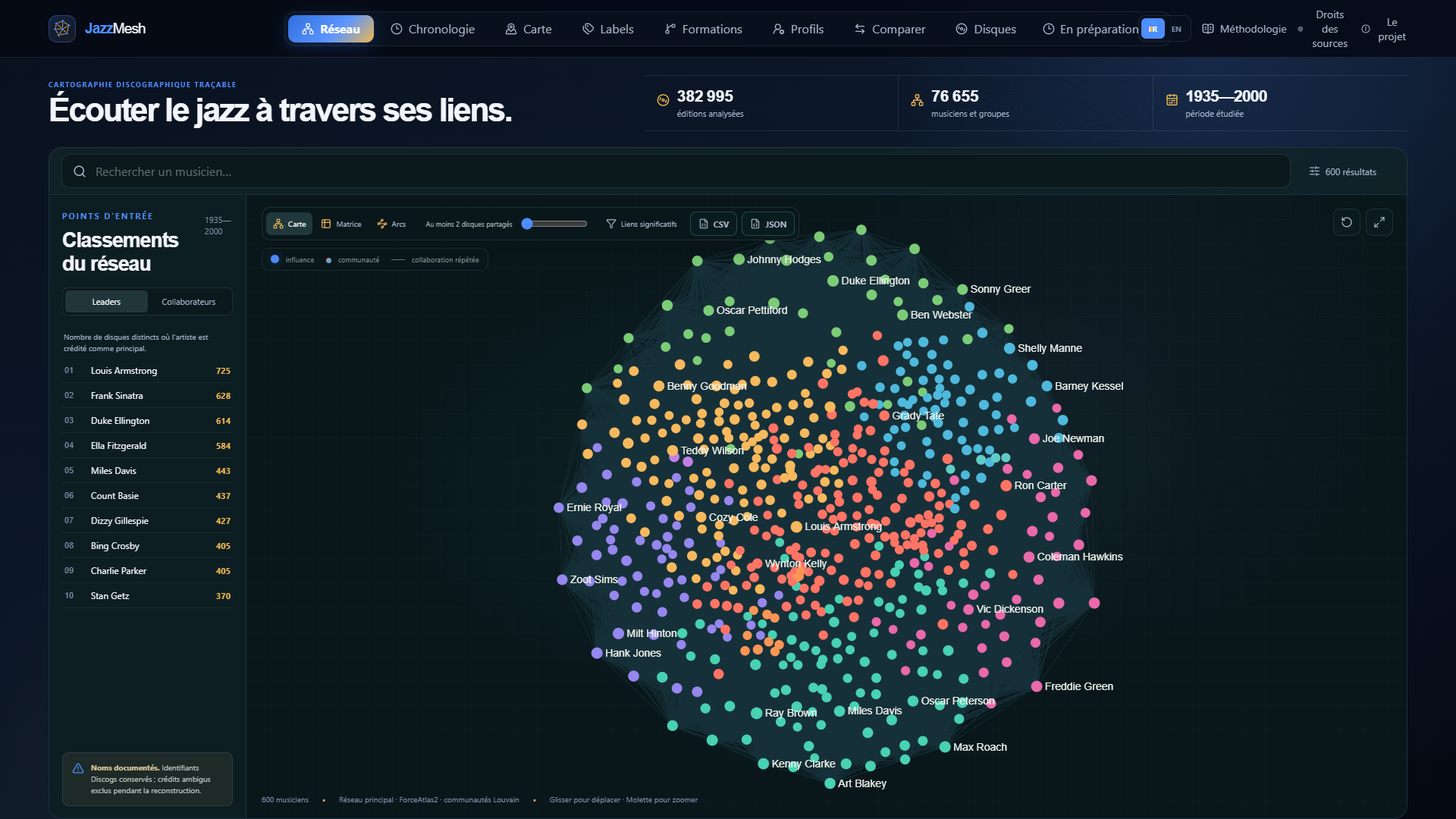
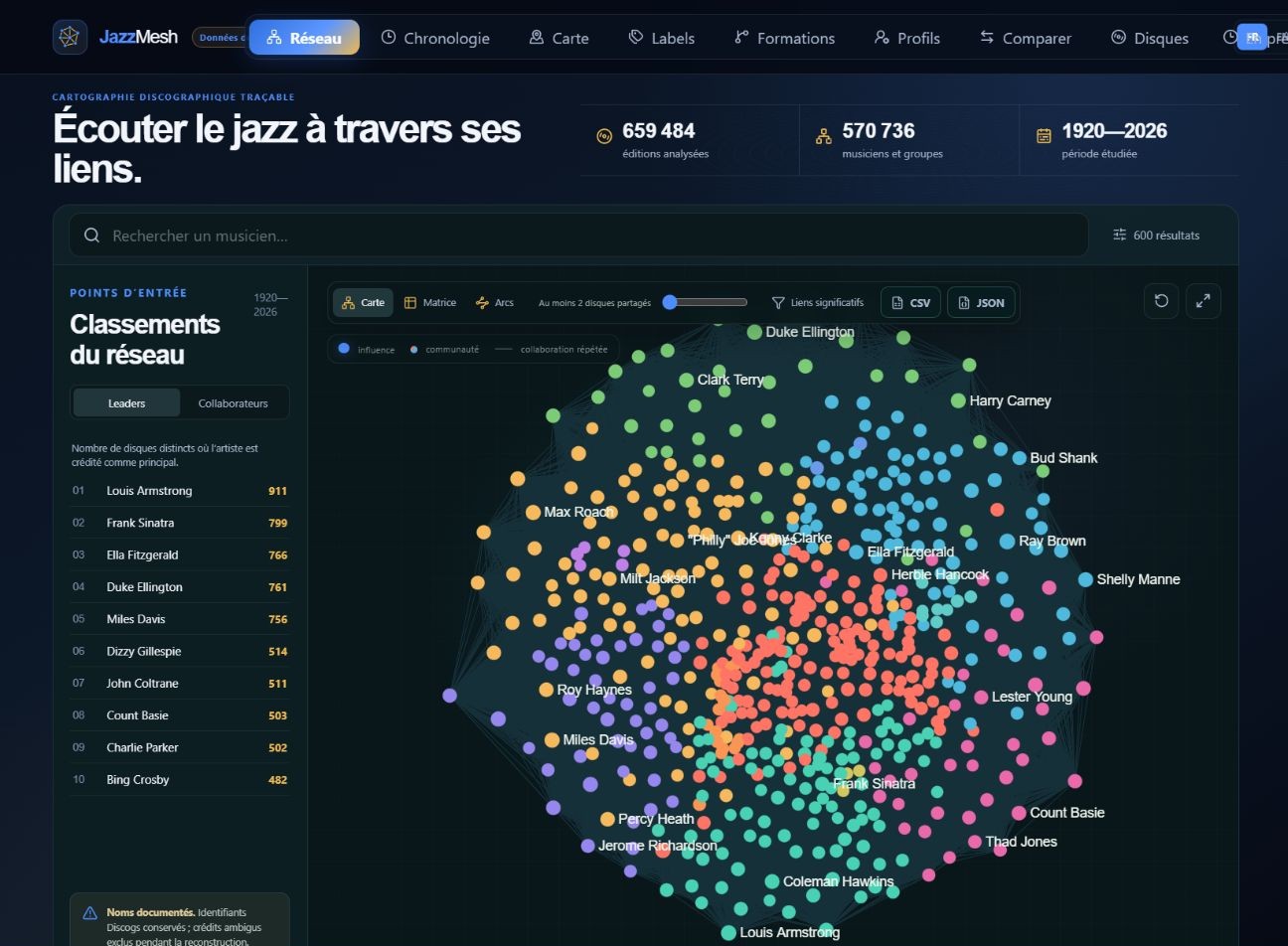
The general network displays only 600 musicians and applies a threshold of at least two shared records. In this reduced view, Miles Davis is connected to 226 visible nodes; the complete profile contains 1,017. The difference is a reminder of an essential rule of graph analysis: centrality always depends on the scope, threshold and unit of calculation.
This central position does not prove that Miles was objectively the most important musician in jazz. It indicates that, within the published corpus, his name crosses an exceptional number of discographic neighbourhoods. His analytical interest lies less in a single score than in the diversity of paths he makes possible.
Four indicators for measuring Miles’s position
- 226
- degreeDirect collaborators in the public 600-musician view.
- 0.008675 · 12th/600
- betweennessExact, unweighted, normalized shortest-path score.
- 4 → 7 → 4 → 5 → 7
- communities crossedLouvain communities among Miles’s neighbours, from the 1940s to the 1980s.
- 74.7 → 50.0 → 40.2 → 40.2%
- neighbourhood turnoverJaccard distance between successive decade neighbourhoods.
In the public view of 600 musicians, Miles Davis has a degree of 226: he has 226 direct collaborators connected by at least two shared discographic objects. His normalized betweenness is 0.008675, ranking 12th out of 600. This measure calculates the share of the network’s shortest paths that pass through him; it therefore describes a structural capacity to connect neighbourhoods, not artistic influence.
The weighted Louvain calculation shows that his collaborators belong to 4 communities in the 1940s, 7 in the 1950s, 4 in the 1960s, 5 in the 1970s and 7 in the 1980s. These communities are calculated separately in each decade view: they are neither aesthetic schools nor stable historical categories.
Neighbourhood turnover is the share of collaborators entering or leaving between two decades, divided by the union of the two neighbourhoods. It reaches 74.7% between the 1940s and 1950s, 50.0% between the 1950s and 1960s, then 40.2% for both the 1960s–1970s and 1970s–1980s transitions. The first shift is the sharpest: 22 collaborators remain visible, 5 leave and 60 enter. These results concern release decades in the corpus, not a certified chronology of recording sessions.
1945–1952: between bebop and another idea of the ensemble
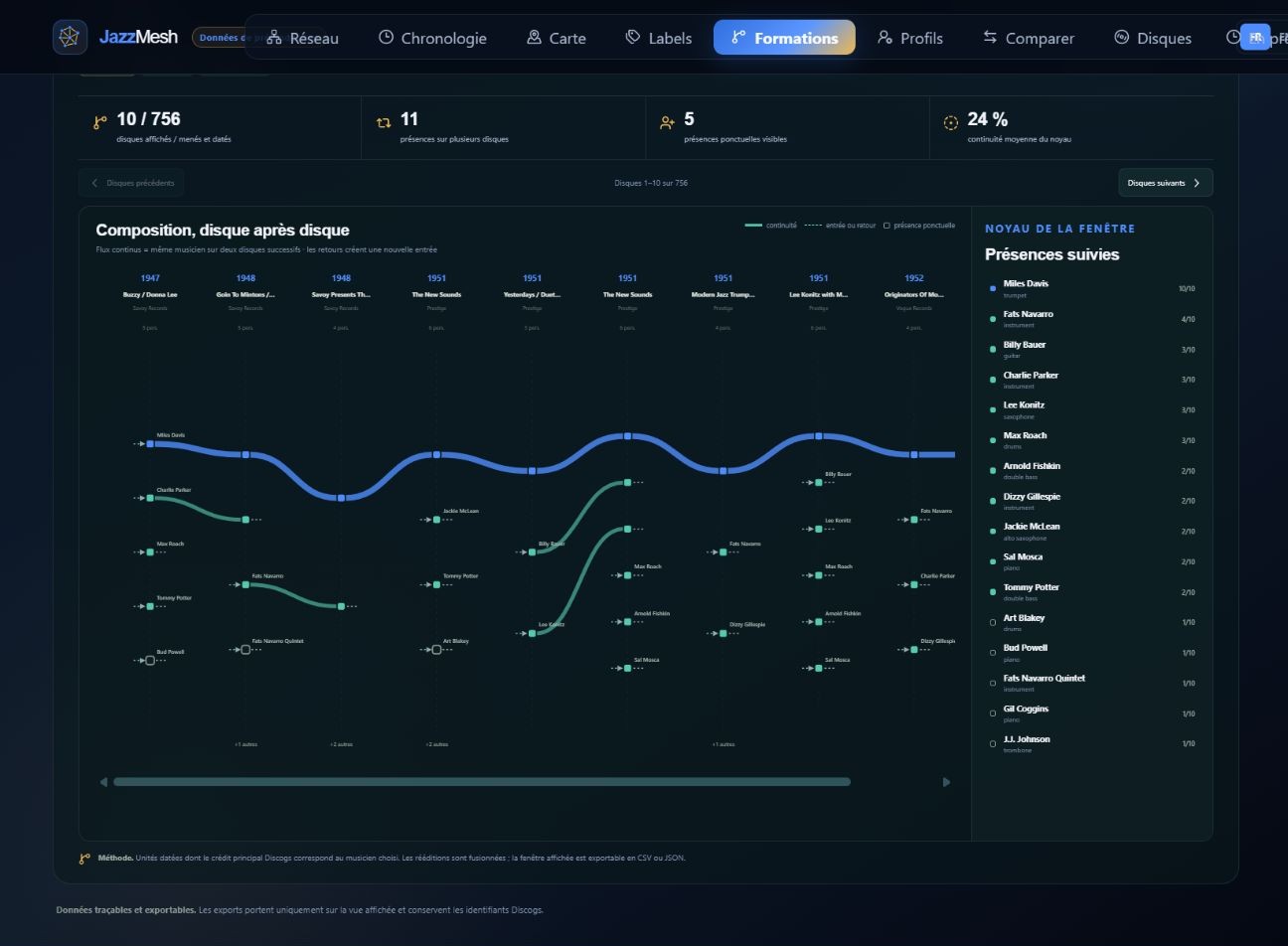
The first window of ten records led by Miles shows Charlie Parker on three objects, Max Roach on three, and then Lee Konitz and guitarist Billy Bauer on three each. Fats Navarro appears on four objects in this window. The juxtaposition is telling: it places the bebop world alongside the explorations of timbre, arranging and collective balance associated with the future Birth of the Cool.
The National Endowment for the Arts biography confirms the context: Davis was playing with Charlie Parker in New York by 1945, then worked in the late 1940s with the circle around Gil Evans, Gerry Mulligan, Lee Konitz and John Lewis. JazzMesh does not demonstrate this aesthetic development; it makes the recurring participants and points of passage visible. The graph suggests the question, while the historical source gives it meaning.
The first great quintet: an architecture of relationships
- 279
- shared objectsTheir common discographic footprint, including reissues and compilations.
- 375
- common collaboratorsIdentities connected to both musicians in the corpus.
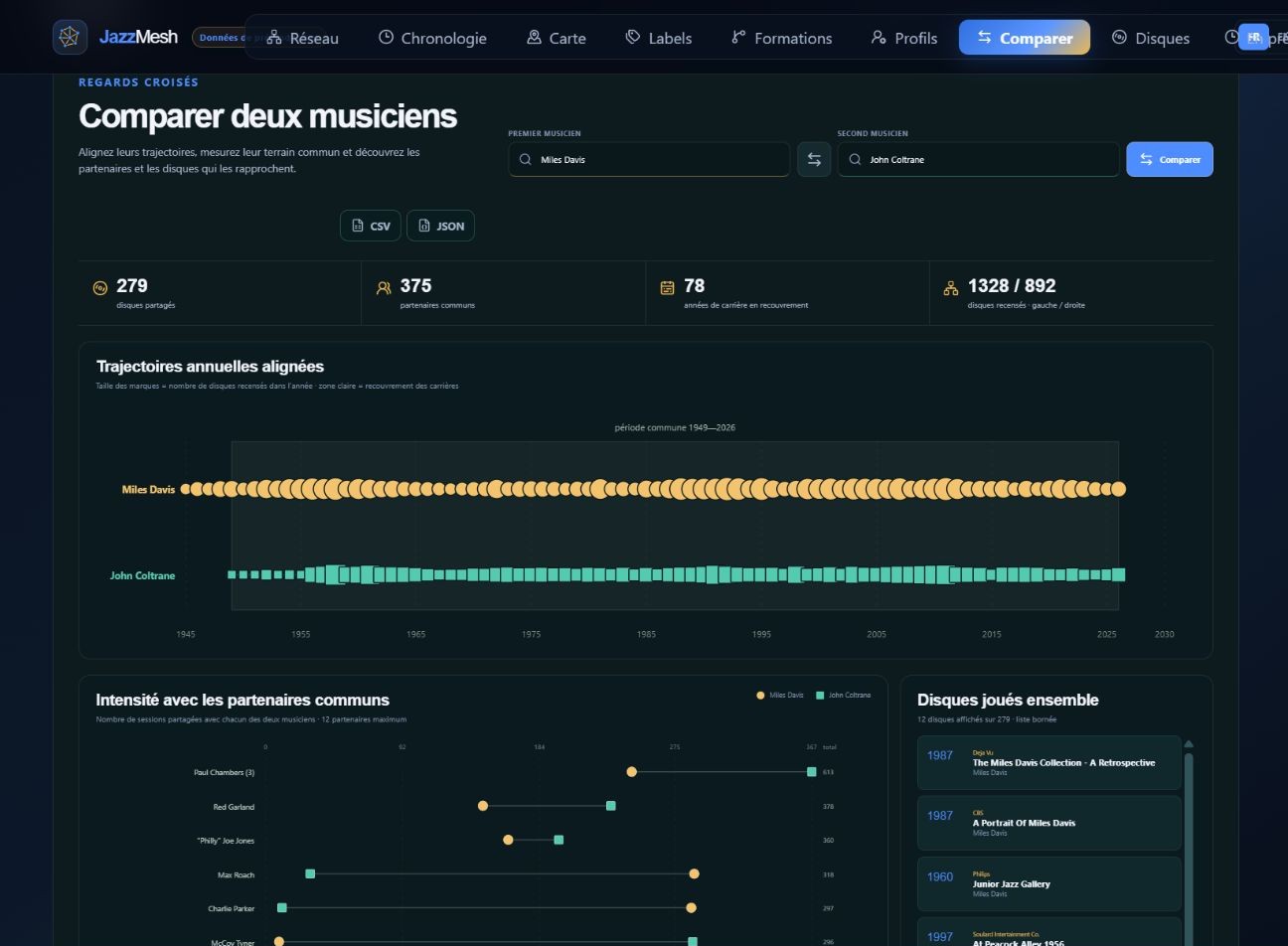
- 1,328 / 892
- objects indexedMiles Davis on the left, John Coltrane on the right.
From 1955, the group with John Coltrane, Red Garland, Paul Chambers and ‘Philly’ Joe Jones forms one of the clearest cores around Miles. In the JazzMesh comparison between Miles Davis and John Coltrane, Paul Chambers, Red Garland and ‘Philly’ Joe Jones lead the common collaborators by combined relationship weight.
The calculation finds 279 discographic objects shared by Davis and Coltrane, along with 375 common collaborators. These totals are far higher than the number of historical quintet sessions because the same recordings circulate as reissues, anthologies and compilations. The figure 279 must therefore be read as the discographic footprint of their association in the corpus, not as 279 studio encounters.
Kind of Blue: a crossroads rather than an isolated monument
The Library of Congress added Kind of Blue to the National Recording Registry and notes that the album was recorded and released in 1959. The Smithsonian locates its importance in the use of modes as a basis for improvisation, extending the ideas of George Russell.
Seen through JazzMesh, the album becomes a crossroads: Miles Davis connects John Coltrane, Cannonball Adderley, Bill Evans, Wynton Kelly, Paul Chambers and Jimmy Cobb, among others. The record is no longer only a canonical destination. It becomes an interchange leading towards Bill Evans’s trios, Coltrane’s groups, Cannonball Adderley’s albums, or the trajectories of Chambers and Cobb.
The second quintet: Miles as an organiser of potential
The NEA dates the formation of the second great quintet with Wayne Shorter, Herbie Hancock, Ron Carter and Tony Williams to 1964. In a graph, this group is particularly interesting: each of these musicians later has a considerable independent network. Miles therefore connects more than sidemen to his own catalogue; he temporarily assembles several future centres of the network.
This is where value analysis sheds light on the leader’s role. The value created lies not only in Miles’s trumpet or in the number of records under his name. It also lies in his ability to select singular voices, sustain a space in which they interact, and then allow each of them to carry the transformation elsewhere.
From the quintet to the electric groups: the network changes logic
At the turn of the late 1960s, In a Silent Way and then Bitches Brew shift the neighbourhood again. Electric keyboards, guitars, multiple percussionists and studio editing broaden the ensemble and bring together musicians who will themselves become major points of entry: Herbie Hancock, Chick Corea, Joe Zawinul, John McLaughlin, Wayne Shorter and Jack DeJohnette.
The graph does not say that all these artists share the same aesthetic. It shows a structural change: a relatively stable small group gives way to larger, modular ensembles connected to several scenes. Musical transformation can then be read as a recomposition of the collective as much as a change of sound.
Posterity disrupts chronology — and reveals the catalogue’s power
The JazzMesh curve remains active long after 1991, with a peak of 32 objects in 1992 and many publications through 2026. Read literally, this graph would be misleading. Read as editorial history, it becomes valuable: it measures how box sets, reissues, rediscovered concerts and compilations continually renew the presence of Miles Davis.
This afterlife also explains some surprising connections. A compilation may bring together on one object musicians who never took part in the same session. Before interpreting a link as a direct historical collaboration, the record, its type and release year must therefore be opened and, when necessary, checked against a session discography.
Three listening paths to build in JazzMesh
First path: Charlie Parker → Miles Davis → Lee Konitz. It moves from bebop to the ensemble experiments of the late 1940s without claiming that the three repertoires sound alike. The connecting thread is the documented presence of musicians across several configurations.
Second path: Miles Davis → John Coltrane → McCoy Tyner. It starts with the first quintet, then gradually leaves Miles’s orbit through one of Coltrane’s most strongly connected collaborators. Third path: Miles Davis → Wayne Shorter → Joe Zawinul. It follows the second quintet towards the electric groups and opens a listening route in which human and discographic relationships matter more than a style label.
What the analysis can establish — and what it leaves open
JazzMesh can establish that a set of identities is co-credited on identified discographic objects, count those objects under public rules and compare the resulting neighbourhoods. It can also identify cores, bridges and changes of personnel that deserve further investigation or listening.
It measures neither artistic influence, sonic affinity nor the quality of a contribution. It does not replace a session discography. Its strength lies elsewhere: starting from a familiar name, making each branch explainable and showing that Miles Davis’s trajectory resembles less a line than a succession of temporary networks — each capable of generating the next.